Fraser Island Tide Times: When The Beach Is Drivable
The east beach of K'gari (Fraser Island) is a road, and the tide decides when it is open. This guide explains how the tide windows work, why every tour on the island leaves at a set time, and what the driving rules are on the sand.
Short answer
Beach driving on K'gari is best at low tide or within two hours either side of it, when the sand near the waterline is firm. Queensland Parks advises driving on the harder sand between the waterline and the high tide mark. Tour schedules are built around these windows, which is why day tours leave early and run to fixed times.
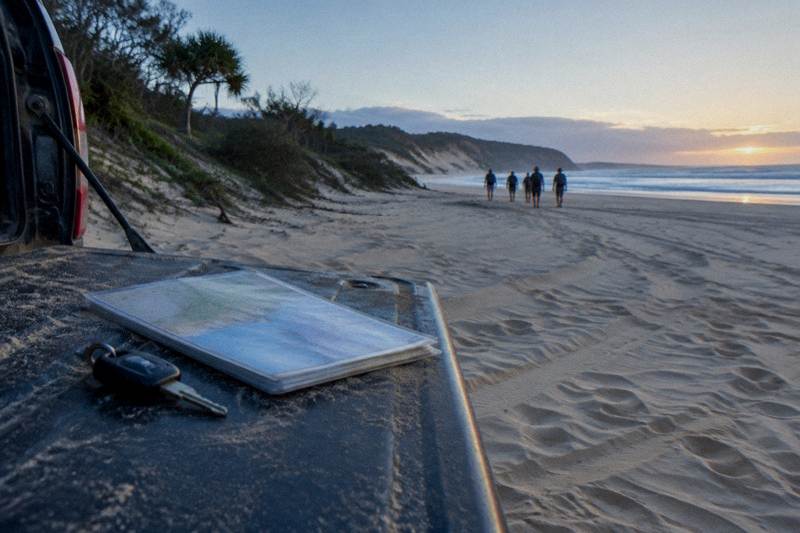
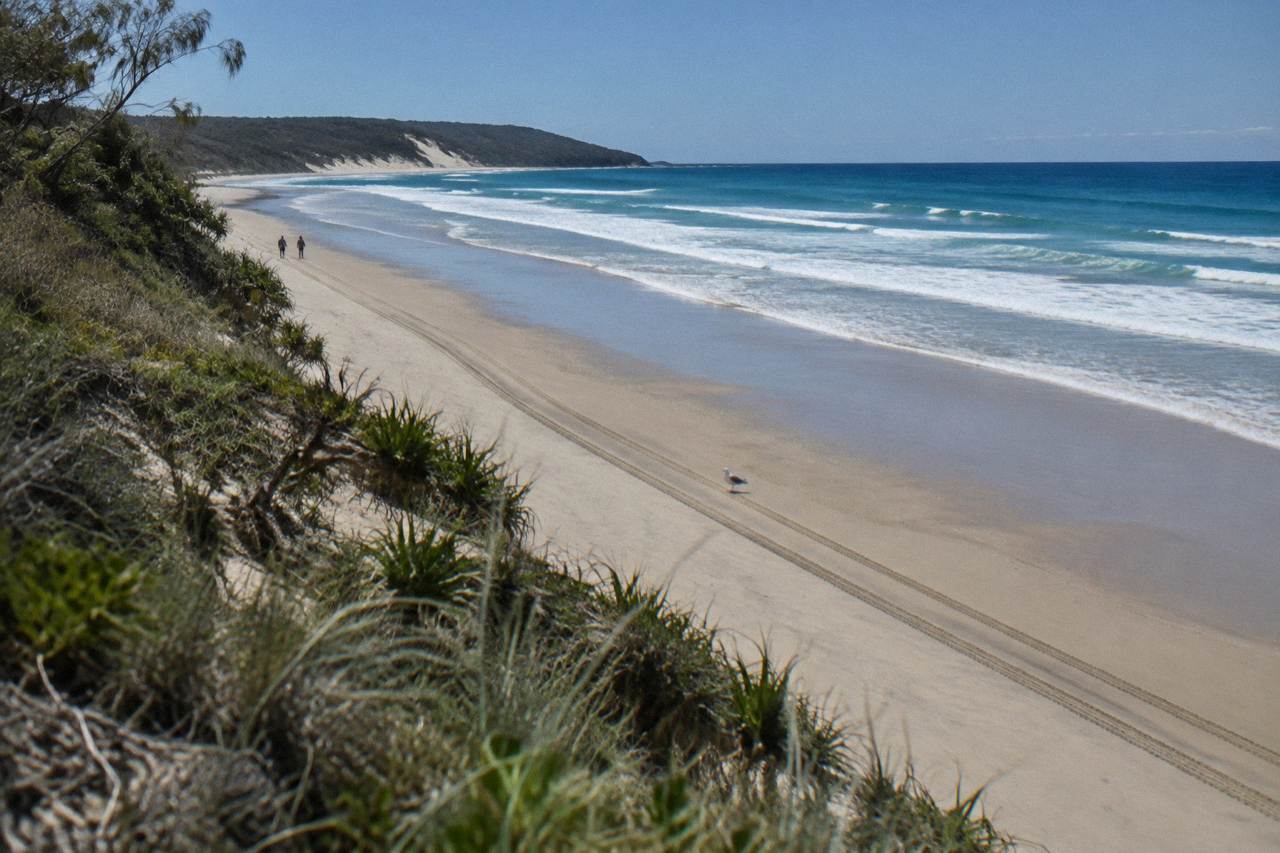
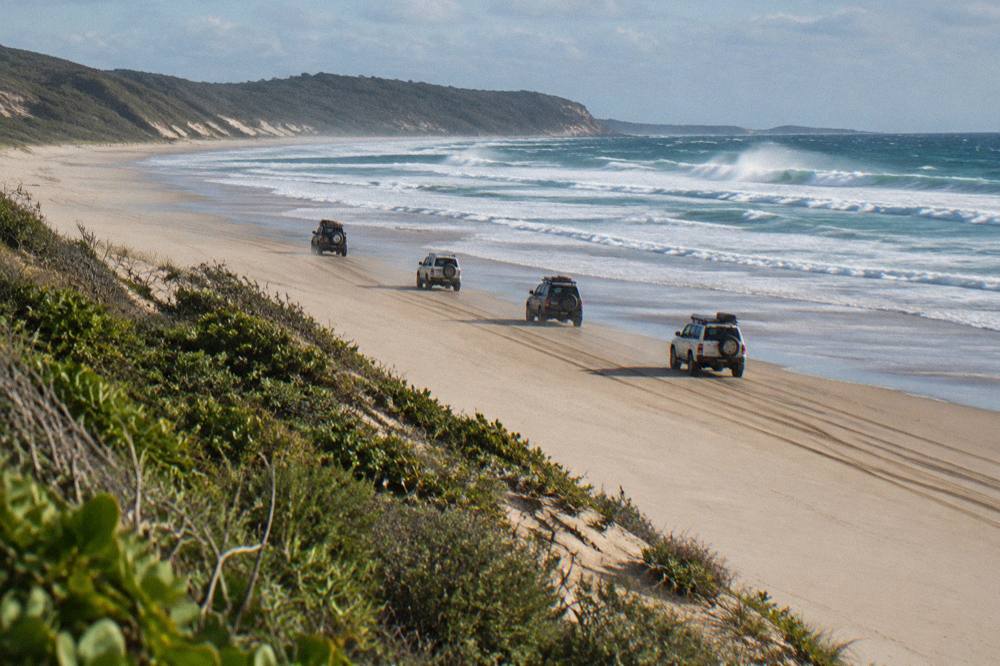
The east beach of K'gari (Fraser Island) is a declared road, and it is the main artery of the island: coaches, tag-along convoys and private 4WDs all run up and down the sand between Hook Point and the creeks and sights further north. But unlike a sealed road, this one changes twice a day. When the tide runs high, the soft dry sand above the waterline is all that remains, and that sand bogged vehicles by the dozen. When the tide drops, a band of firm, wet sand opens up and the beach becomes a highway. Queensland Parks puts it plainly: travel at low tide or within two hours either side, on the harder sand between the waterline and the high tide mark, and expect to reduce tyre pressure for the conditions.
That single piece of guidance explains almost everything about how a day on the island is structured. The nine-hour coach day tour with lunch does not leave Hervey Bay at a particular time because the operator likes early mornings; it leaves then because the tide window demands it. The same goes for the small group 4WD day tours out of Rainbow Beach and Noosa, and for the two and three day tag-along trips where guests drive their own vehicles in a convoy. Tide times are not a footnote to planning a K'gari trip, they are the planning.
This guide sets out how the tide works on the island, how to read a tide table, what the driving rules are on the sand, and how the tours on this site build their schedules around the water. If you are weighing a guided day tour against driving yourself, the tide is the first thing to understand and the last thing to ignore.
Why Do Tides Decide When You Can Drive On Fraser Island?
The east beach is the island's main road, and only the lower part of it is firm enough to drive on. As the tide rises, that firm band disappears and vehicles are pushed onto soft dry sand where they bog easily. Queensland Parks advises driving at low tide or within two hours either side of it, on the harder sand between the waterline and the high tide mark.
The physics is simple. Wet sand at the waterline is compacted and holds a vehicle's weight; dry sand higher up the beach is loose, and a tyre spinning in it digs itself into a hole within seconds. At low tide the exposed wet band is wide, often tens of metres, and there is room for two-way traffic, overtaking and a comfortable run at the 80 km/h beach speed limit. As the tide climbs, that band narrows. Drivers crowd closer together, then start pushing up onto the soft sand to pass, and that is where most beach recoveries happen. Queensland Parks' own driving on sand guidance names the two hour window either side of low tide as the best travelling time, and also asks drivers to reduce tyre pressure for the sand and re-inflate when back on hard surfaces.
There is a second, harder limit that has nothing to do with sand softness. Sections of the east beach are bounded by rocks, creek crossings and headlands, and at high tide some of these become impassable altogether, with water reaching the obstacles. A vehicle caught on the wrong side of a rising tide can end up stranded for hours, or swept on to rocks. Locals and rangers describe the tide as a gate that closes twice a day. Planning is not about avoiding the beach at high tide out of caution; it is about recognising that for part of every day the road genuinely is closed.
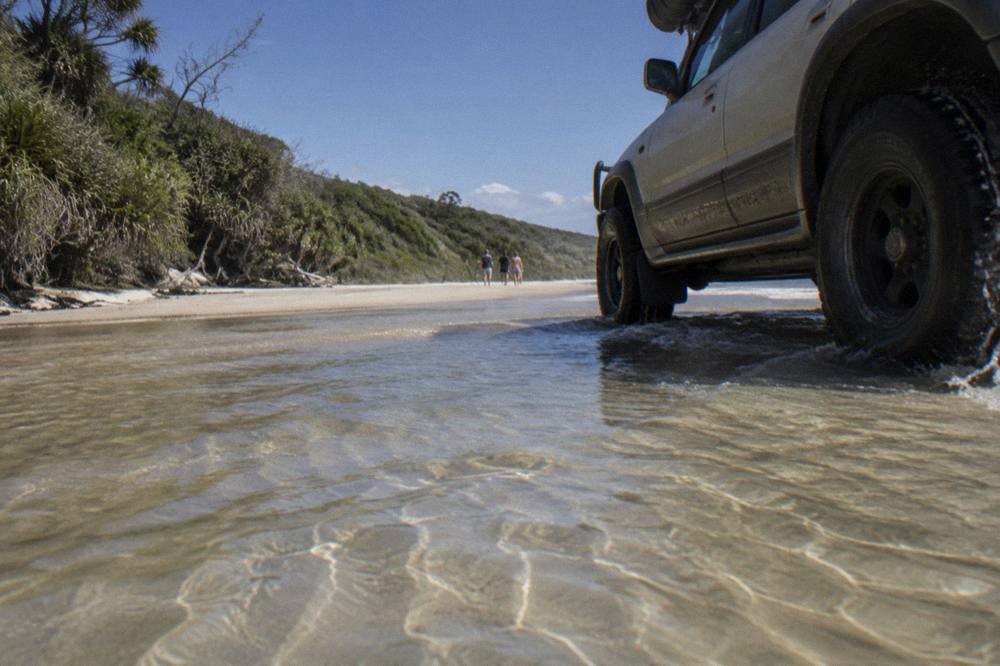
This is also why the island's tours are so consistent about their departure times. A guided 4WD day tour has a fixed circuit: the beach run, Lake McKenzie, a creek stop, the rainforest boardwalk, lunch, and the run home. Every leg between those stops is timed against the tide. The small group day tour out of Noosa runs about eleven hours, and the Rainbow Beach small group full day tour runs about ten, not because the sights take that long to see but because the drive between them is tide dependent. Operators build slack into the schedule for exactly this reason.
For travellers, the practical takeaway is this: on any given day, the safe driving window on the east beach is roughly four hours wide, centred on low tide, and everything else on the island is scheduled around it. If a proposed itinerary, whether your own or a tour's, does not account for that window, it is not a real itinerary.
How Do You Read A Fraser Island Tide Table?
Look up the daily low tide times for the Hervey Bay or Rainbow Beach region before you plan any driving, and treat the two hours either side of low tide as the drivable window. Check whether the day has one low or two, note the tide height in metres, and always confirm against the official conditions report before travelling, because conditions change.
Tide tables for the Fraser Coast are published by the Bureau of Meteorology and republished widely, and any departure town's visitor information centre will have them. What matters is less the exact number than the shape of the day. A day with a single low at midday gives one long window. A day with two lows, one at dawn and one at dusk, gives two short ones, which suits the multi day tours that move camp each day but not a day trip that wants a single run up the beach.
The height matters too. Lows are not equal: a low of 0.3 m exposes far more firm sand than a low of 1.1 m, and a high tide coinciding with big swell can push water further up the beach than the table suggests. Queensland Parks maintains a K'gari conditions report that is updated regularly, and the park alerts page carries notices that can affect access at any time. Reading the tide table is step one; reading the alerts page is step two, and the two together are what an experienced island operator does every single morning before a vehicle rolls on to the sand.
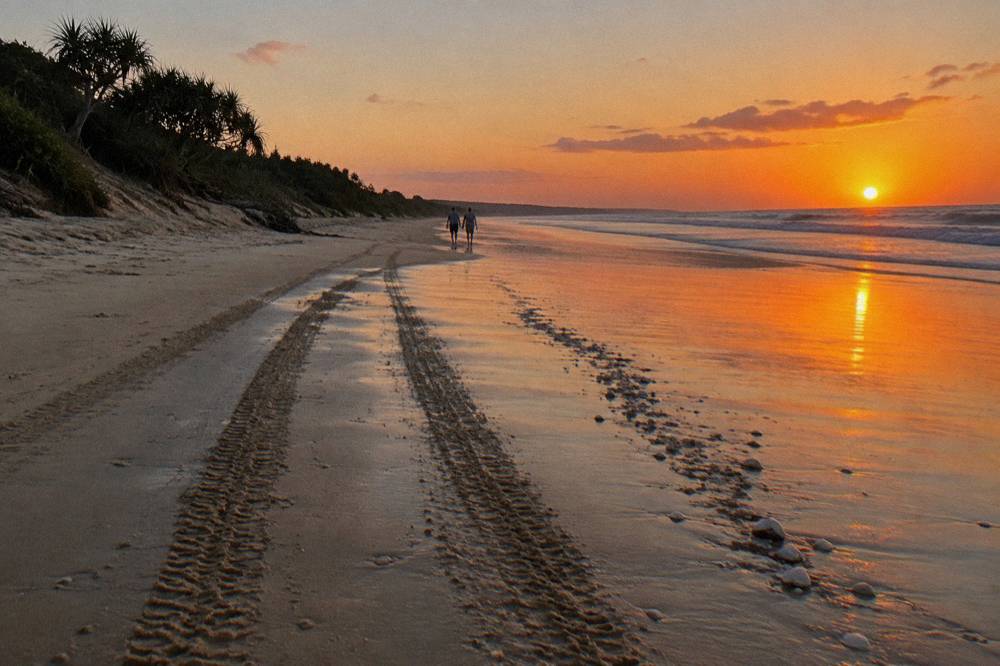
One habit worth copying from the operators: plan the whole day backwards from the afternoon low tide, not forwards from a morning departure. If the tide says the beach run home must happen by mid afternoon, the tour must leave the last stop by early afternoon, which means lunch is earlier than you would expect and the first stop is at dawn. Guests sometimes read an early start as over-organisation; it is actually the tide schedule written into human terms.
If that level of planning sounds like work, it is, and it is the single biggest argument for a guided day tour over a self drive attempt. The trade offs between the two are laid out in the site's 4WD hire versus guided tour comparison, which runs the numbers on cost, risk and time on the sand.
The table below summarises how the tide shapes a typical tour day, hour by hour, so you can see the window working rather than just read about it.
| Tide Phase | Beach Condition | What Tours Do |
|---|---|---|
| Two hours before low tide | Firm wet sand widening | Beach run north begins, first stops scheduled |
| Low tide | Widest firm band, full access | Longest driving legs, creek crossings made |
| Two hours after low tide | Firm band narrowing | Vehicles move to inland tracks and lake stops |
| Mid tide to high tide | Soft sand, some sections impassable | Lake swims, boardwalk walks, lunch, camp time |
| Falling tide again | Firm sand returning | Beach run home timed before the window closes |
With the window understood, the question becomes which tour actually fits it, and that depends on where you start and how long you have.
Which Tours Run On The Tide, And When Do They Leave?
Every 4WD tour on this roster builds its day around the tide window: the coach day tours from Hervey Bay and Rainbow Beach run roughly nine hours to one day, the small group tours from Noosa and Rainbow Beach run ten to eleven hours, and multi day tours move camp in the low tide windows each day. Departure times are set by the water, not by guest preference.
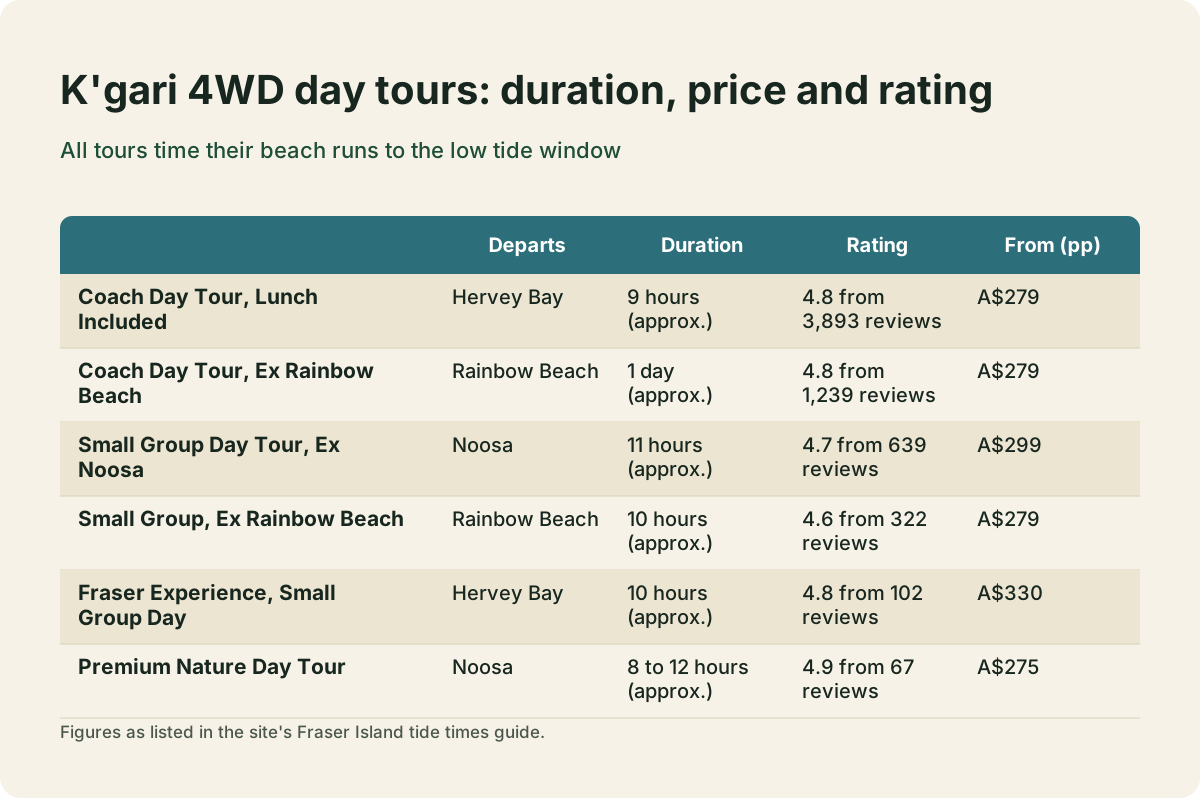
The pattern is easiest to see in the day tours. The K'gari Explorer Tours coach day tour from Hervey Bay runs about nine hours and includes lunch, from A$279 per person, with a rating of 4.8 from 3,893 reviews. The same operator's one day coach tour ex Rainbow Beach, also from A$279 per person and rated 4.8 from 1,239 reviews, covers the same logic from the southern departure. Both are large group 4WD coaches, which means the driver is a professional who runs the beach every working day and reads the tide the way a commuter reads traffic. One guest review of the Hervey Bay coach tour sums up the shape of the day: "It was a busy, but great day full of experiences and lots of knowledge from our guide Dean.We can highly recommended it."
The small group options trade coach capacity for flexibility. The Fraser Experience small group full day guided tour from Hervey Bay caps the group at 17, runs about ten hours, and is rated 4.8 from 102 reviews, from A$330 per person. Smaller vehicles can move a little faster through the tide window and spend longer at each stop, which is why the small group tours out of Noosa (about eleven hours, 4.7 from 639 reviews, from A$299) and Rainbow Beach (about ten hours, 4.6 from 322 reviews, from A$279) run longer days than the coaches while seeing comparable sights. The premium nature day tour from Noosa, rated 4.9 from 67 reviews and from A$275, runs eight to twelve hours depending on the day, a range that itself tells you how much the tide and track conditions shape the schedule. If you're still deciding which of these styles suits you, the side by side comparison of every Fraser Island day tour names a clear pick for each type of traveller.
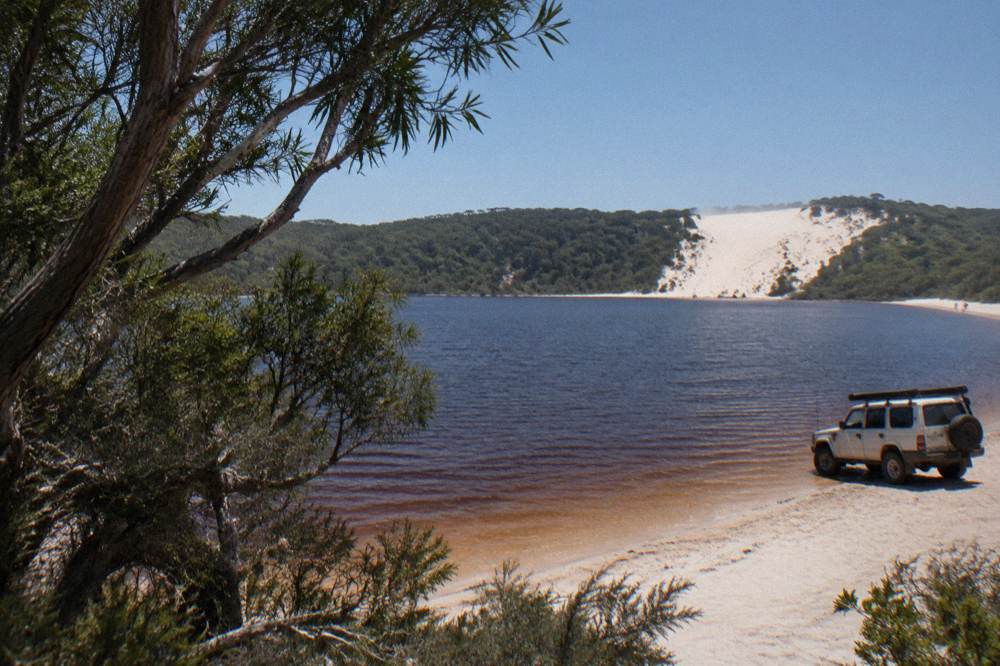
The multi day tours treat the tide as a daily rhythm rather than a single hurdle. The two day K'gari Explorer tour with a lodge or resort stay (4.9 from 1,120 reviews, from A$549), the two day beach house 4WD adventure ex Hervey Bay (4.8 from 245 reviews, from A$659) and the Pippies three day glamping adventure ex Rainbow Beach (4.8 from 364 reviews, from A$659) all move their vehicles in the low tide windows and use the high tide hours for lake swims, boardwalk walks and camp time. That is not a compromise, it is good design: the hours the beach is closed are exactly the hours you would rather be at Lake McKenzie anyway.
The table below puts the day tours side by side, with the schedule facts that matter when you are matching a tour to a tide day.
| Tour | Departs | Duration | Format | Rating | From (per person) |
|---|---|---|---|---|---|
| Coach Day Tour, Lunch Included | Hervey Bay | 9 hours (approx.) | 4WD coach, large group | 4.8 from 3,893 reviews | A$279 |
| Coach Day Tour, Ex Rainbow Beach | Rainbow Beach | 1 day (approx.) | 4WD coach, large group | 4.8 from 1,239 reviews | A$279 |
| Small Group Day Tour, Ex Noosa | Noosa | 11 hours (approx.) | Small group 4WD | 4.7 from 639 reviews | A$299 |
| Small Group, Ex Rainbow Beach | Rainbow Beach | 10 hours (approx.) | Small group 4WD | 4.6 from 322 reviews | A$279 |
| Fraser Experience, Small Group Day | Hervey Bay | 10 hours (approx.) | Small group (max 17) | 4.8 from 102 reviews | A$330 |
| Premium Nature Day Tour | Noosa | 8 to 12 hours (approx.) | Minibus and 4WD | 4.9 from 67 reviews | A$275 |
Every one of these listings includes lunch and pickup where stated, and all of them include the National Park fees, which matters more than it sounds: park fees and permits are part of the cost of any island day, and a tour that folds them in removes a whole layer of planning. Free cancellation is offered on every tour in the roster, with the exact cutoff shown on each listing before you book if your travel dates are still settling.
What Are The Speed Limits And Driving Rules On The Sand?
The eastern beach carries an 80 km/h maximum, inland roads are 30 km/h, the Hook Point inland road is 50 km/h, beach pedestrian areas are 40 km/h and shared use areas are 10 km/h. Queensland road rules apply in full, seatbelts are required, and Queensland Parks advises driving on the harder sand between the waterline and the high tide mark at low tide or within two hours either side.
The speed limits are not arbitrary. The 80 km/h beach maximum exists because the beach is a road with soft edges, pedestrians fishing at the waterline, aircraft landing on some stretches at times, and vehicles emerging from inland tracks without warning. The 40 km/h zones around beach pedestrians and the 10 km/h shared use areas exist because most of the island's foot traffic shares the same strip of sand as its vehicle traffic. Queensland Parks lists rollovers and unrestrained passengers as the common causes of serious accidents on the island, which is why the seatbelt rule is enforced exactly as it would be on a city street. Everything else covered here is indexed on Kgari Island Tours.
The tide interacts with the rules in one specific way: the drivable window is narrow, and the temptation in a narrow window is to hurry. A vehicle racing the rising tide is the classic island accident scenario, and it is entirely avoidable by leaving a margin. Operators do this by scheduling the return leg an hour before the window closes. Private drivers should do the same, and if the tide will beat you, wait it out. The beach will still be there in four hours.
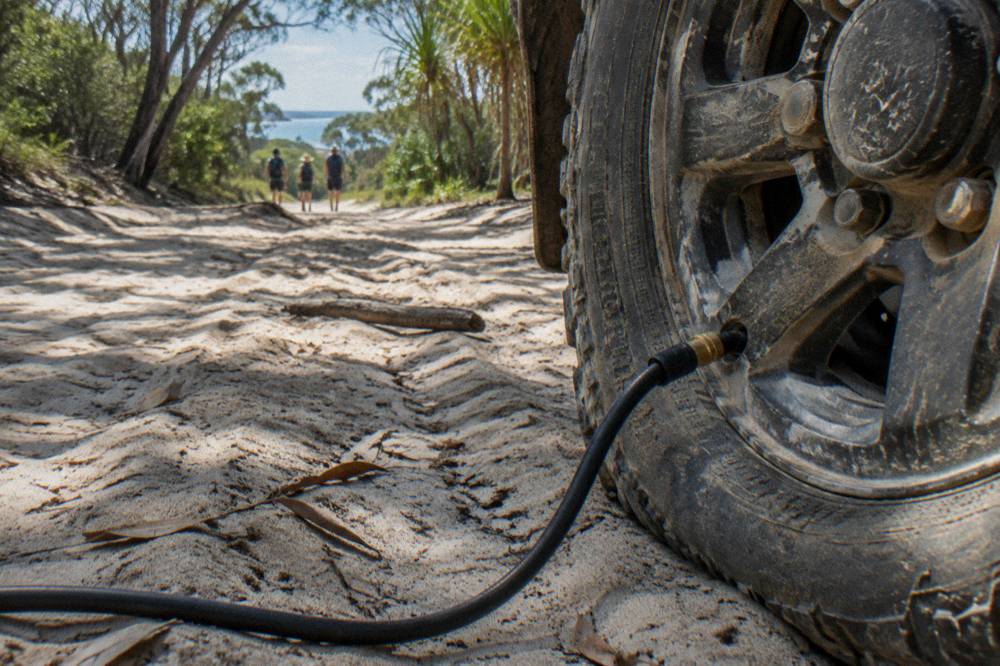
Tyre pressure is the other half of the equation. Queensland Parks advises reducing pressure within the manufacturer's specifications for sand and tracks, and re-inflating on hard surfaces. A tyre at highway pressure will cut into soft sand and dig in; the same tyre aired down floats on the surface. Every tour driver on the island does this instinctively, and it is one of the clearest arguments for the tag along format, where you drive your own 4WD behind a lead vehicle that calls the pressure changes and the pace. The tag along tour guide covers that format in detail.
Do You Need Your Own Permit, Or Does The Tour Cover It?
Every vehicle driven on the island needs a vehicle access permit: A$61.80 for one month or less, or A$311.00 for longer, up to a year, bought before you arrive. Tour guests do not buy one, because the operator holds the permit and the listings state that National Park fees are included. Driving without a valid permit draws a $518 penalty infringement notice.
The vehicle access permit, usually shortened to VAP, is a Queensland Parks requirement for every vehicle entering the K'gari (Fraser Island) Recreation Area, and there is no one day or one week option published: the shortest window is one month or less at $61.80, with the annual option at $311.00. A combined K'gari and Cooloola permit carries a 20 percent discount for travellers planning to drive both areas. Permits must be bought before arrival, because mobile reception on the island is unreliable and they cannot be bought from rangers once you are there. The details are covered in full in the site's vehicle permit guide.
For tour guests, none of this applies directly, and that is a genuine saving of money and hassle. The operator holds the permit for the vehicle you are riding in, and the tour listings on this site state that National Park fees are included in the price. When the coach day tour from Hervey Bay is advertised from A$279 per person with lunch, that price already carries the park's cut. A private driver pays the permit, the barge crossing, the fuel and the vehicle wear on top of everything else, and those fares and fees are set by the operators and Queensland Parks, change over time, and must be checked on their pages rather than assumed.
The comparison is not just financial. A permit is a piece of paper; what it buys is the right to figure out the tide, the sand, the creek crossings and the speed limits on your own. A tour folds all of that into a driven day. For most first time visitors, and for anyone travelling with children or older relatives, that difference decides the whole trip.
What About Driving Yourself: Hire And Tag-Along Options?
Self drive options on the island are the tag along tours, where you drive your own hired 4WD behind a lead vehicle, and independent hire, where you plan the tide, permit and crossing alone. The tag along format from Rainbow Beach starts from A$589 per person for two days and from A$659 for three days, with the lead guide calling the tide windows and driving decisions.
The tag along format is the honest middle ground. Dingos K'gari Adventures runs a two day tag along tour rated 4.8 from 106 reviews, from A$589 per person, and a three day version rated 5.0 from 1,128 reviews, from A$659 per person, both departing Rainbow Beach with lunch included. You drive, but you drive in a convoy behind a guide who reads the tide, sets the tyre pressures, chooses the camp and manages the creek crossings. One guest review of the three day trip captures the appeal: "It was an amazing experience! I really enjoyed being disconnected from the world for a few days because theres no wifi on the island. Driving on the beach is so much fun and our tourguide Waide was the best!"
Independent hire is a different proposition, and the site's 4WD tour guide walks through it. The driver alone owns the tide planning, the permit, the barge booking and the recovery if the sand wins. It suits experienced sand drivers and long trips; it suits a first time visitor much less. The one thing both formats share is that the tide rules them equally: a convoy moves in the low tide window exactly as a coach does.
The table below compares the self drive formats against a guided day tour on the planning dimensions the tide touches most.
| Option | Who Drives | Tide Planning | Permit | Best For |
|---|---|---|---|---|
| Guided day tour (coach or small group) | Professional guide | Built into the schedule | Held by operator | First time visitors, families, short stays |
| Tag along 2 or 3 day tour | You, behind a lead vehicle | Guide calls the windows | Held by operator | Confident drivers wanting the wheel |
| Independent 4WD hire | You alone | Entirely your responsibility | You buy the VAP | Experienced sand drivers, long trips |
Which Departure Town Suits Your Tide Day?
Hervey Bay suits resort side touring and boat departures, Rainbow Beach gives the fastest sand crossing to the island's southern end, and Noosa suits travellers already on the Sunshine Coast who accept a longer day. None of the tours on this roster depart from Brisbane; the nearest real departures start at Hervey Bay, Rainbow Beach and Noosa.
The departure town changes the shape of the tide day. From Rainbow Beach, the Manta Ray barge crosses from Inskip Point to Hook Point in about ten minutes, turn up and go, every day of the year, which puts a vehicle or a tour bus on the southern beach quickly. From Hervey Bay, SeaLink runs vehicle and passenger ferries from River Heads to Kingfisher Bay Resort in about 45 minutes, and vehicle ferries need advance booking. Fares are set by the operators, change, and must be checked on their pages; tour guests never touch a barge booking at all, because every roster tour includes the crossing.
Brisbane deserves a plain word, because the search results often blur it. A Brisbane day trip to K'gari is a long day: the drive to Hervey Bay or Rainbow Beach alone eats most of a morning, and no live tour on this roster departs from Brisbane. The listings start at Hervey Bay, Rainbow Beach or Noosa, and the honest plan is to overnight in a departure town and take a tour from there. The site's tours from Rainbow Beach guide covers the southern gateway, and the Hervey Bay guide the western one.
The table below sets out the three real departure towns and what each means for a tide driven day.
| Departure Town | Crossing To The Island | Typical Day Tour Day Length | Suits |
|---|---|---|---|
| Hervey Bay | SeaLink ferry from River Heads, about 45 minutes | About 9 to 10 hours | Resort side touring, boat and whale options |
| Rainbow Beach | Manta Ray barge from Inskip Point, about 10 minutes | About 10 hours to 1 day | Fast access to the southern east beach |
| Noosa | Coach and 4WD via the Cooloola coast | About 11 hours | Sunshine Coast based travellers |
Season matters too, though less than people expect. Hervey Bay's climate averages put the January mean maximum at 30.3 C and July's at 21.8 C, with March the wettest month and September the driest. The tide runs the same in every season; what changes is how many other vehicles are sharing the window with you.
Common Questions About Fraser Island Tide Times
How many hours either side of low tide can you drive on the Fraser Island beach?
Queensland Parks advises travelling at low tide or within two hours either side of it, on the harder sand between the waterline and the high tide mark. That gives a practical window of roughly four hours centred on low tide, wider on a very low tide and narrower on a high one.
Do tour operators check the tide times on Fraser Island?
Yes, and their schedules are built around them. Every 4WD tour on this roster, from the nine hour coach day tour with lunch to the multi day tag along trips, plans its driving legs in the low tide windows and uses the closed hours for lake stops, walks and meals. That is why departure times are fixed rather than flexible.
Can you drive on the beach at high tide on Fraser Island?
It is not advisable and in places it is not possible. At high tide the firm wet sand is submerged and vehicles are pushed onto loose dry sand where they bog easily; some rock sections and creek crossings become impassable. Queensland Parks' guidance is to travel at low tide or within two hours either side.
Do I need a vehicle access permit if I take a tour?
No. The operator holds the permit for the vehicle, and the tour listings state that National Park fees are included in the price. A permit, at $61.80 for a month or less, is only needed for a private vehicle driven on the island.
What is the speed limit on the Fraser Island beach?
The eastern beach carries an 80 km/h maximum, with 40 km/h in beach pedestrian areas, 10 km/h in shared use areas, 30 km/h on inland roads and 50 km/h on the Hook Point inland road. Queensland road rules apply in full and seatbelts are required.
Where do I check current conditions before driving on the island?
Queensland Parks maintains a K'gari conditions report and a park alerts page, both updated regularly. Conditions and access can change at short notice, so read the alerts page on the day you travel, and never assume yesterday's conditions still hold.
Whichever way you travel, the tide is the one schedule on the island that no operator, guide or driver can negotiate with. A guided tour simply hands the problem to someone who solves it every day, and the three day tours below all build their itineraries around the same window you have just read about.
For a Sunshine Coast departure, the small group day tour from Noosa covers the same tide driven circuit with pickup in town, and makes a good fit for travellers staying further south.