What Is So Special About Fraser Island?
Fraser Island, now officially K'gari, is the world's largest sand island, a World Heritage site where rainforest grows from sand, lakes sit high above the sea and dingoes roam free. Here is what makes it special and how to see it.
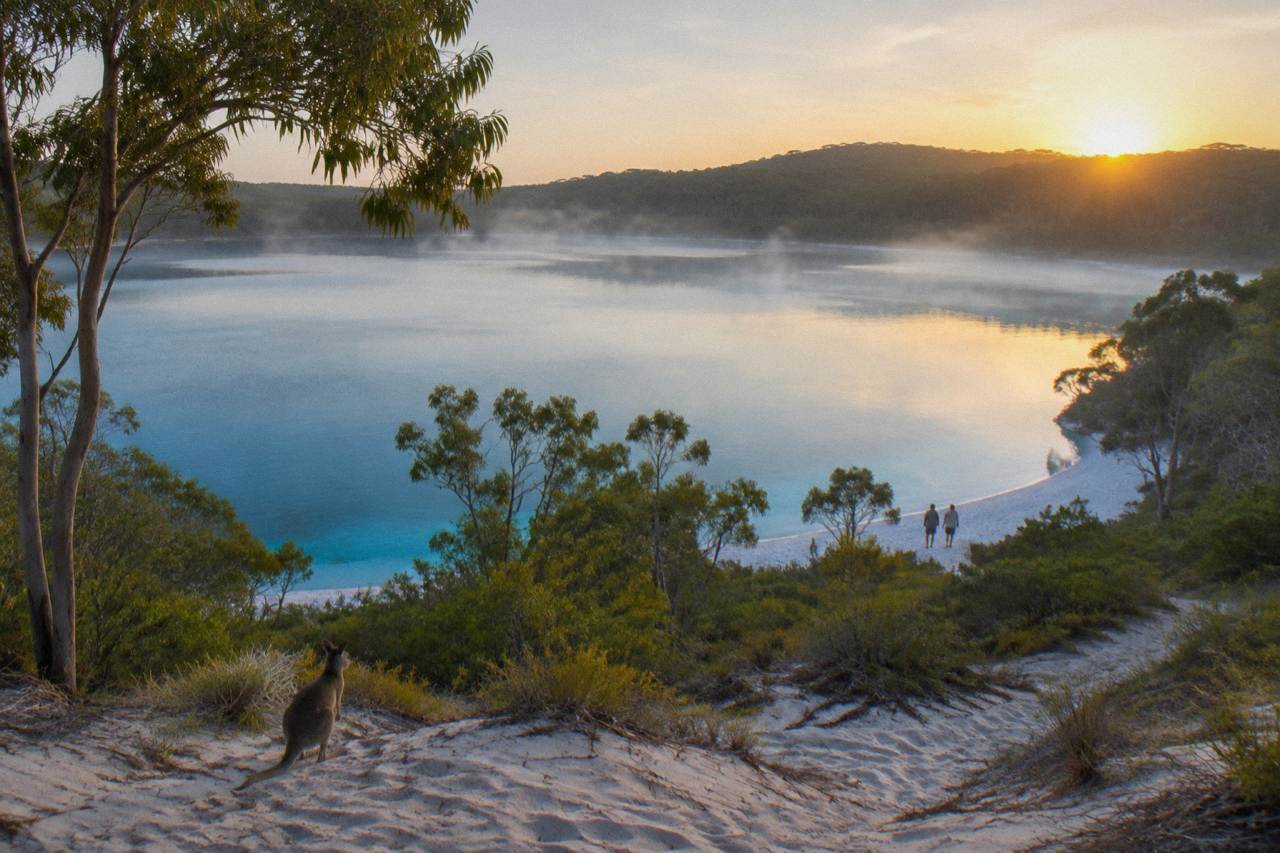
Fraser Island, officially K'gari since the name change was completed in stages, is the only place on earth where a sand island this size grows a rainforest on top of itself. Everything that makes it special flows from that single strange fact: sand that should drain and shift instead holds freshwater lakes high above sea level, supports trees that are centuries old, and forms a 123 km spine of beach, bush and water that was added to the UNESCO World Heritage List in 1992. Queensland Parks describes it as the world's largest sand island, covering 166,038 hectares, and the listing itself cites over 250 km of clear sandy beaches. That sheer scale shapes every itinerary, so if you're wondering how much time to set aside, our guide to K'gari's length and what it means for your trip covers driving times and how many days you'll want.
The island is not just a scenic oddity. It is Butchulla Country, home to a protected dingo population, and it sits beside Hervey Bay, one of the best places on the east coast to watch humpback whales. For travellers, the practical question is how to see a place with no sealed roads and no patrolled beaches, and the answer is almost always a tour. The nine-hour coach day tour with lunch included from Hervey Bay is the most popular way to compress the island's highlights into a single day, while boat tours and multi-day options reach corners a day trip cannot.
What Is So Special About Fraser Island?
Fraser Island is special because it is the largest sand island in the world, a World Heritage site where rainforest grows directly on sand, holding more than half of the world's known perched lakes, patrolled by a protected dingo population and shaped by 60,000 years of Butchulla connection. No other place combines all of these on a single sand mass.
Start with the sand itself. Most sand islands are thin ribbons of dune with scrub on top. K'gari is a 123 km long landmass of overlapping dune systems built up over hundreds of thousands of years, complex enough that its dunes record long sequences of climatic change. The World Heritage citation recognises ongoing geological and biological processes, which is a technical way of saying the island is still actively demonstrating how landscapes form.
Then there is the freshwater. Rain falling on the dunes filters through the sand at a rate slow enough to build up a huge lens of groundwater, which feeds creeks, swamps and the island's famous perched lakes. A perched lake sits above the regional water table, held in a bowl of cemented sand and organic matter, sometimes tens of metres above sea level. Lake Boomanjin, the world's largest perched lake, is here, along with the better known Lake McKenzie (Boorangoora).
Add rainforest that grows directly on sand, the tallest recorded scribbly gums, banksias and syncarpia thriving in a soil that should be too poor to support them. Add the wongari, the island's dingo population, possibly among the purest remaining in eastern Australia and protected by law. Add the fact that the whole 166,038 hectare island has no sealed roads, so every journey is a 4WD run along a beach or a sandy inland track. That is the short list of what makes this place genuinely unusual, and each item deserves a proper look.
For visitors weighing how to actually see it, the roster of verified tours splits into three practical shapes: a coach day tour with lunch, a small-group nature day tour, and a boat-based day on the water.
| Tour format | Listing | From price | Rating and reviews | Duration |
|---|---|---|---|---|
| Coach day tour with lunch | K'gari (Fraser Island) All Inclusive Day Tour | from A$279 | 4.8 from 3,893 reviews | 9 hours |
| Small-group nature day tour | Fraser Island/K'gari: Nature Day Tour | from A$275 | 4.9 from 67 reviews | 8 to 12 hours |
| Boat tour with lunch | Remote K'gari Tour by Boat with Lunch | from A$269 | 4.9 from 1,321 reviews | 9 hours |
All three include lunch and free cancellation, with the exact cutoff shown on each listing, and all three include the National Park fees, so guests do not need to arrange permits themselves. The coach tour is the workhorse: a large 4WD vehicle that carries a full day of Lake McKenzie, rainforest boardwalks and the eastern beach in one loop out of Hervey Bay. One guest review on the listing calls it "a busy, but great day full of experiences and lots of knowledge from our guide Dean.We can highly recommended it."
The World's Largest Sand Island, And Why That Matters
K'gari is 123 km long and covers 166,038 hectares, making it the largest sand island on earth, and it was inscribed on the UNESCO World Heritage List in 1992 for its ongoing geological and biological processes. Its dune systems record a long history of climatic and sea level change. All that sand, sun and remote terrain calls for a bit of preparation, so our guide to what you should pack for a K'gari tour is well worth a read before you set off.
The island's size is not a trivia point. It is the reason the island can hold so many different environments at once: ocean beach on the east, calm strait on the west, freshwater lakes and swamps in the middle, and tall forest on dunes that have been stable for hundreds of thousands of years. UNESCO's listing for the property, which covers 181,851 hectares including adjacent small islands, cites the world's largest sand island and the sheer length of its sandy beaches as outstanding universal values, and you can read the full citation on the UNESCO World Heritage List entry.
What a sand island this size means in practice is that the landscape keeps working when you are standing on it. Sand moves. The beach is a designated road, a landing strip and a fishing spot all at once, and it reshapes with every storm. Inland, the dunes have been accumulating in overlapping phases, and the island's shape today is a snapshot of a process still running. Queensland Parks summarises the island's natural values on its official K'gari (Fraser Island) page.
The scale also explains the island's pull for wildlife. A sand mass this large, with permanent freshwater and no sealed roads through its core, holds habitats that have mostly vanished from the mainland coast. That is why the island matters to more than beachgoers, and it is why the practical question of how to move across it matters so much.
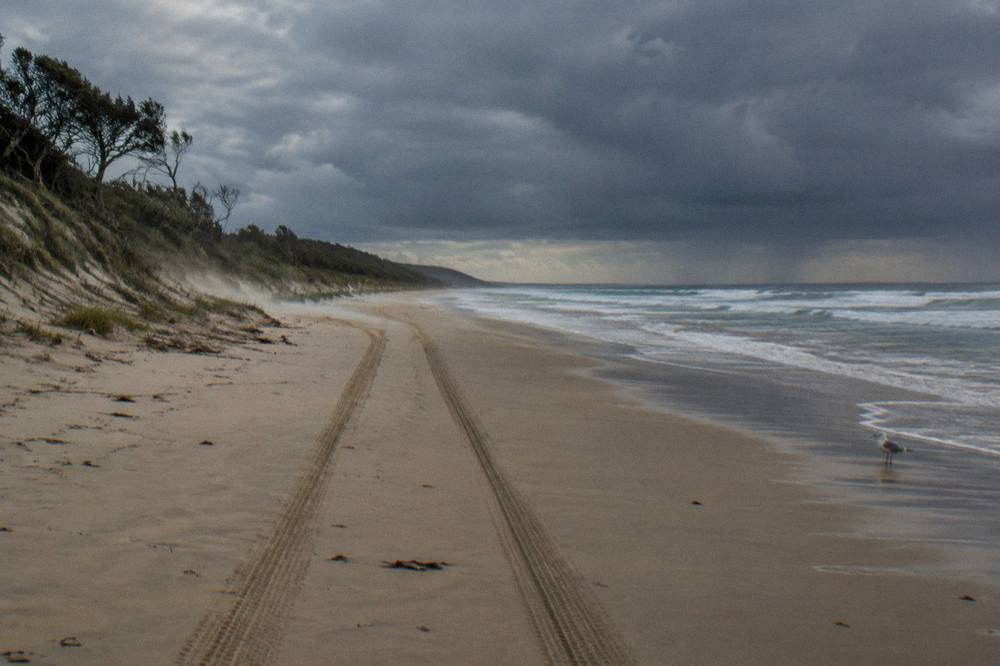
Getting across that landscape is the one real friction. Every vehicle needs a high-clearance 4WD, every vehicle needs a recreation area permit, and the eastern beach doubles as the main highway, driven at low tide or within two hours either side of it. This is the honest case for a tour: the operator holds the permits, drives the sand every day and carries the lunch. For a deeper comparison of the options, the guide to Fraser Island day tours compared breaks down every format on the roster side by side.
Wondering which single day trip gives you the most of the island for the money?
Lake McKenzie And The Perched Lakes
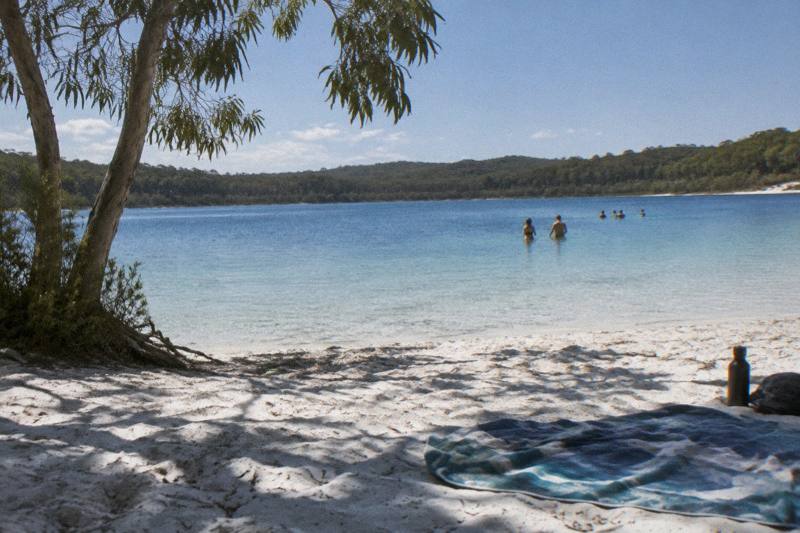
More than half of the world's known perched lakes sit on K'gari, including Lake McKenzie (Boorangoora), a body of freshwater held in a sand bowl high above the water table, so pure and so low in nutrients that almost nothing can live in it. The water is famous for its shifting blues.
A perched lake is a hydrological oddity. Rainwater percolates through the dune sand, hits a hard layer of cemented sand and organic material, and pools above it. The lake is not connected to the regional water table or to the sea. It just sits there, in some cases tens of metres above sea level, on top of a sand dune, in a cup of its own making.
Lake McKenzie is the one most visitors see, and it is the island's single most photographed place. The sand around it is white silica, the water is clear enough to see the ripples on the bottom several metres out, and the colour shifts from pale green to deep blue as the depth changes. The lake's water is so low in nutrients that it supports very little life, which is precisely why it stays so clear. Swimmers are asked to take no food except drinking water to the lake shore, and to skip sunscreen before swimming, because even small amounts of nutrient change the lake's chemistry. If you're wondering exactly what creates that shifting colour, the science behind Lake McKenzie's blue water explains it in plain terms.
The swimming note matters here, because the lakes are the island's only real swim option. The ocean around K'gari is unpatrolled, with rips, sharks and a marine stinger risk that runs higher from November to May, and Queensland Parks advises plainly against swimming in it. The lakes are the answer, and the full reasoning is laid out in why you can't swim at Fraser Island.
For a sense of how much the lakes shape a visit, it helps to look at how the tours are built around them. Nearly every land-based day tour on the roster lists Lake McKenzie as a headline stop, and the timings work because the coach and small-group formats run the same proven loop.
| Day tour | Departure | Format | Lake McKenzie stop |
|---|---|---|---|
| K'gari (Fraser Island) All Inclusive Day Tour | Hervey Bay | 4WD coach, large group | Yes, headline stop |
| Discover K'gari's Best in One Epic Day | Rainbow Beach | 4WD coach, large group | Yes, headline stop |
| From Noosa: K'gari (Fraser Island) Tour | Noosa | Small group 4WD | Yes, headline stop |
| From Rainbow Beach: K'gari Full-Day Tour | Rainbow Beach | Small group 4WD | Yes, headline stop |
| Fraser Experience Small Group Full Day Guided Tour | Hervey Bay | Small group, max 17 | Yes, headline stop |
One guest on the Hervey Bay coach day tour described the balance of the day plainly: "Butch was great!" That pairing, a lake and a dingo sighting, is the island in one sentence, and it is what a well-run day tour is engineered to deliver.
Rainforest Growing Straight Out Of Sand
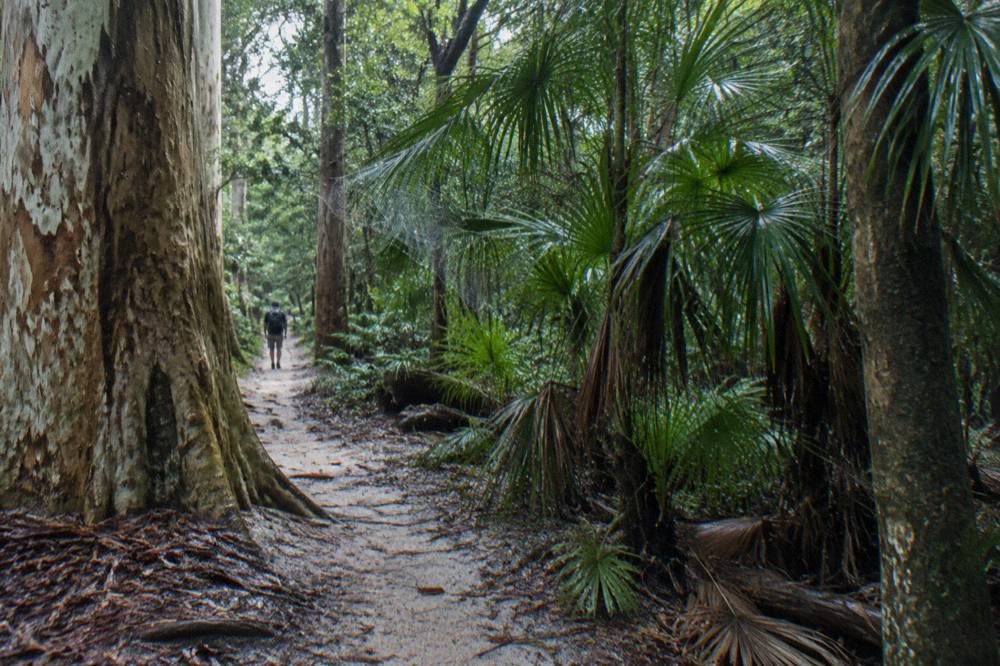
K'gari's rainforest grows directly on sand dunes, some of them hundreds of thousands of years old, without the rich soils rainforest normally needs. The trees survive on nutrients recycled through the sand and a slowly building layer of humus, and some reach heights unmatched anywhere else growing in these conditions.
This is the fact that made the World Heritage listing possible. Tall eucalypt forest, rainforest and scrub all grow on dune systems whose parent material is almost pure silica sand. The forests do it by recycling their own nutrients with extraordinary efficiency: leaf litter breaks down fast, roots and fungi grab every available mineral before it leaches away, and the whole system runs on a closed loop. Queensland Parks notes that the island's soils are among the least fertile on which such tall forests grow anywhere in the world.
Walk into the Valley of the Giants or the Pile Valley circuit near Central Station and the mechanics are visible. Scribbly gums with bark marked by moth larvae, satinays tall enough to have been logged for shipbuilding in the island's timber era, and kauri pines standing in sand you can sink a hand into. The contrast is the point. In most of the world, sand means coastal scrub. Here it means canopy.
The rainforest also explains the creeks. Wanggoolba Creek at Central Station flows over a bed of white sand through a rainforest gully, so clear it looks like the water is not there. Eli Creek on the eastern beach pours out of the dunes at a volume that carves the beach itself. Both are groundwater made visible, the same lens of filtered rainwater that fills the perched lakes, surfacing where the dune profile drops.
A tour that leans into this side of the island is the small-group nature day tour, which runs from Noosa and Rainbow Beach by minibus and 4WD and carries a 4.9 rating from 67 reviews, from A$275 per person with lunch and park fees included. It is the roster's most nature-forward day trip, and its guide-to-guest ratio suits travellers who want the ecology explained rather than just shown.
Wongari: The Island's Dingoes
K'gari's dingoes, known as wongari, are a protected population considered possibly the purest remaining strain of dingo in eastern Australia, and the island is one of the few places where they live largely apart from domestic dogs. Disturbing or harming one carries a maximum fine of $28,495, and failing to store food securely can cost $6,908.
The wongari are the island's most controversial residents. They are not pets and not pests: they are an apex predator that shapes the island's ecosystems, hunting everything from bandicoots to beached marine animals, and they are protected under Queensland law. The fines are not theoretical. Queensland Parks states the maximum penalty for disturbing or harming a dingo at $28,495, with an on-the-spot penalty of $2,763, and the maximum for failing to store food securely at $6,908, with an on-the-spot penalty of $518. The rules and the reasoning are published on the Queensland Parks dingo safety page.
The safety rules are simple and strict. Stay at least four car lengths, about 20 m, away from any dingo. Keep children within arm's reach, and never leave them unattended at beaches, lakes or campsites. Walk in groups and do not run or jog, because running triggers a chase. Store all food and rubbish securely, and never feed a dingo, because a fed dingo becomes a dangerous dingo and is usually destroyed as a result. Spring is the wongari breeding and emergence season, when young dingoes are learning to hunt and rangers run an annual alert, so visitors should read the Queensland Parks alerts page before travelling. The rest of the planning pages sit on Kgari Island Tours.
For tour guests, the practical reality is that a guide manages all of this. The coach day tour's commentary covers dingo behaviour and the group stays together, which is exactly what the safety guidance asks for. Campers and self-drivers carry the full responsibility themselves, which is one reason the island's fenced campgrounds are strongly recommended for families with children under 14. The full set of rules and campground advice is in the guide to Fraser Island dingo safety.
Butchulla Country And A Name That Means Paradise
K'gari is the Butchulla name for the island and means paradise, and the Butchulla people's connection to the island spans more than 60,000 years. The island's official name was changed in stages, the national park section first, then the World Heritage Area, then the island itself, with Fraser Island remaining the name most listings still carry.
The name change is often reported as a single event, and that is not quite right. The renaming happened in stages: the national park section became K'gari (Fraser Island) in 2017, the World Heritage Area followed at the 44th session of the World Heritage Committee, and the island's standalone official name became K'gari in 2023 after a public process that drew thousands of submissions. Fraser Island survives in road signs, search terms and most tour listings, which is why this site uses both names.
In the Butchulla creation story, K'gari is the name of a white spirit, a princess sent to help shape the land and seas, who looked at the finished island and asked to stay there forever. She was changed into the island itself, and the Butchulla have cared for it under three laws since: what is good for the land comes first, do not take what you do not need, and do not play with or light fires that you cannot control. The name's meaning, paradise, is not marketing. It is a description written into the story of the place.
That history is not decorative context. It explains the island's management today, from the dingo protections to the way the lakes are treated, and it is the layer a good guide narrates on the drive between stops. The pronunciation catches most visitors: it is GAH-ree, with a silent K, and the details are covered in the guide to K'gari name and pronunciation.
Whales, And The Water Side Of The Island
The waters beside K'gari form one of the east coast's great whale gatherings: humpbacks rest in Hervey Bay between July and October on their southern migration, with operator-published seasons inside that window. Boat tours from Hervey Bay reach remote island beaches that land tours cannot.
Hervey Bay's whale story is unusual. The humpbacks migrating south from the breeding grounds stop in the sheltered bay, between the mainland and the island, and linger for days rather than passing straight through. Estimates suggest a substantial share of the migrating population uses the bay as a resting stop, and the calm, shallow water means mothers and calves are a common sight. The season windows are operator-published and vary slightly by operator, all inside July to October, with August and September the peak. Sightings are wild animals, never guaranteed, though several operators run a free-return policy inside their published windows.
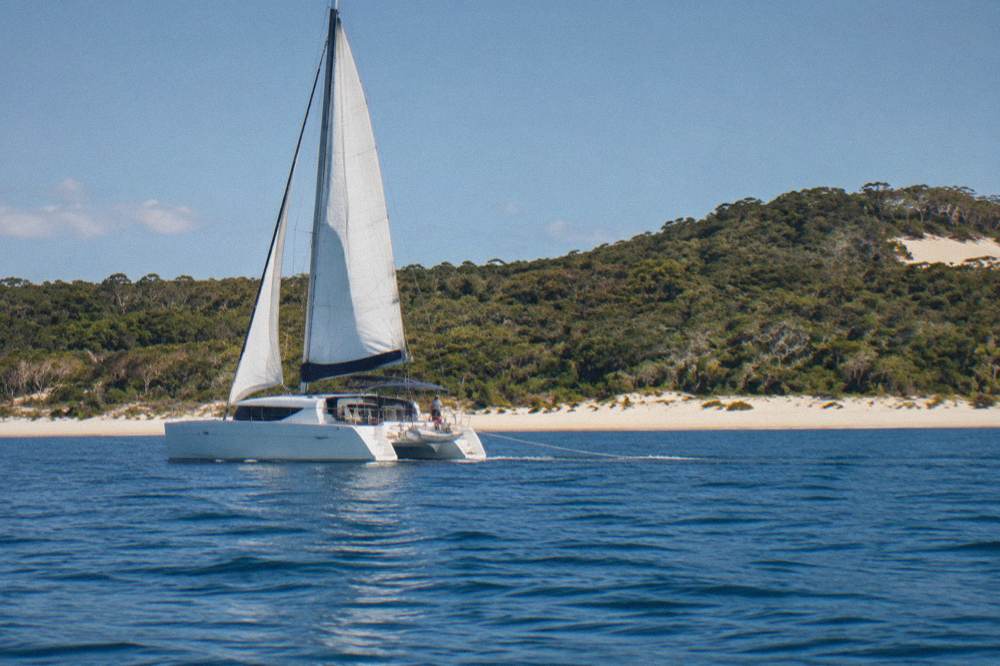
The boat option also changes what an island day looks like. Tasman Venture's remote K'gari tour by boat, from A$269 per person with lunch included and a 4.9 rating from 1,321 reviews, crosses to remote beaches on the island's western side, territory the 4WD day tours do not touch. Its sister listing, the remote island and whale experience, runs the same catamaran format with a swim-with-whales component in season, carrying a 4.9 rating from 503 reviews. Swim-with-whales tours carry a minimum age of 13, and swimming is always on the whales' terms, never forced.
For pure whale watching without the island landing, the roster carries four Hervey Bay cruise options, from the A$119 three-hour research-led cruise to the A$155 four-hour catamaran trips, and the full breakdown is in the guide to Hervey Bay whale watching tours. One guest on a whale cruise put the experience in one line: "This is an absolute must do. Great end to our honeymoon. We saw plenty of whales and the staff were very friendly."
How To Actually See It: The Practical Answer
The honest way to see K'gari is a tour, because the island has no sealed roads, requires a 4WD and a vehicle access permit for every self-driven vehicle, and its beach highway only works around low tide. A day tour from Hervey Bay, Rainbow Beach or Noosa covers the core sights; two or three days covers the island properly.
Self-driving is possible, and some travellers love it, but the friction is real: a high-clearance 4WD with low range, a vehicle access permit bought before arrival, tide-timed beach driving, tyre pressures dropped and reset, and the full weight of dingo-safe food storage. The tag-along tours, where you drive your own vehicle in a convoy behind a guide, split the difference, and the trade-offs are compared in the guide to Fraser Island tag-along tours.
For most visitors the maths favours a tour. The operator holds the permits, the National Park fees are included in the listing price, the guide reads the tide and the sand, and lunch is in the vehicle. A day trip works: the coach day tour from Hervey Bay packs Lake McKenzie, the rainforest and the beach highway into nine hours from A$279 per person, and the question of whether that is enough is worked through in can you do Fraser Island in a day. Two days buys sunset and sunrise on the island, and the options are laid out in the guide to Fraser Island 2 day tours.
Here is how the main formats stack up for a first visit.
| Format | Best for | Typical from price | Trade-off |
|---|---|---|---|
| Coach day tour with lunch | First-timers, one day only | from A$279 | Large group, fixed itinerary |
| Small-group day tour | Nature focus, more guide time | from A$275 to A$330 | Fewer departures, books out earlier |
| Boat day tour with lunch | Calm-water day, remote beaches | from A$269 | No inland sights |
| 2-day resort or lodge tour | Overnight on the island | from A$549 | Needs two days and a night |
| Tag-along, you drive | Drivers who want the wheel | from A$589 | You carry the driving risk |
Whichever shape fits, the underlying advice is the same: book the format that matches your time, not the one with the most stops. The island's scale defeats greediness. A nine-hour coach loop with Lake McKenzie as its centrepiece delivers more of what is special about this place than a rushed self-drive trying to tick every sight in a day.
Common Questions About What Makes Fraser Island Special
What Is So Special About Fraser Island?
It is the world's largest sand island, 123 km long and 166,038 hectares, with rainforest growing directly on sand, more than half of the world's known perched lakes, a protected dingo population and over 60,000 years of Butchulla connection. It has been World Heritage listed since 1992, and its name, K'gari, means paradise.
Is Fraser Island the same place as K'gari?
Yes. K'gari is the island's official name, adopted in stages: the national park section, then the World Heritage Area, then the island itself. Fraser Island remains the name most people search and most tour listings still carry, so both are used interchangeably.
Can you swim in the ocean at Fraser Island?
No. The ocean beaches are not patrolled, and Queensland Parks advises against swimming because of rips, sharks and marine stingers, with the higher stinger risk period running November to May. The freshwater lakes, including Lake McKenzie, are the swimming option.
Are there dingoes on Fraser Island?
Yes, the wongari are a protected dingo population, considered the purest strain remaining in eastern Australia. Visitors must stay at least 20 m away, keep children within arm's reach, store food securely and never feed them. Fines for disturbing a dingo reach $28,495.
Do you need a 4WD to visit Fraser Island?
To drive on the island, yes: it has no sealed roads and every vehicle needs a high-clearance 4WD plus a vehicle access permit. Tour guests do not need either, because the operator holds the permit and does the driving.
Can you see Fraser Island in one day?
Yes, with a day tour. Coach and small-group day tours from Hervey Bay, Rainbow Beach or Noosa cover Lake McKenzie, the rainforest and the eastern beach in eight to eleven hours, with lunch and National Park fees included. Two days is more comfortable, but one well-run day delivers the core sights.